
Let’s be honest: humans will do anything to avoid saying what they really mean — especially when it comes to using the toilet. From “powder room” to “water closet,” “john” to “lavatory,” we’ve spent centuries inventing delicate little euphemisms for one of the most universal needs of all time.
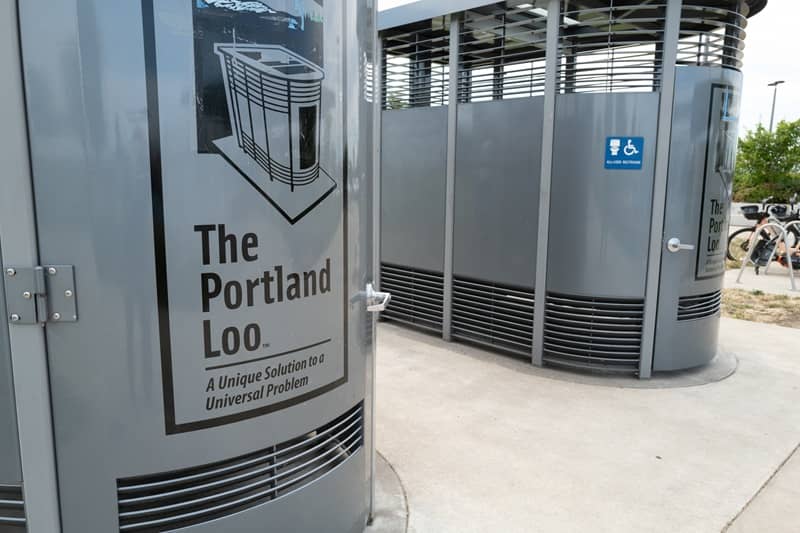
But where did all these terms come from? Why do we call it a restroom when no one’s taking a nap? And how did The Portland Loo® end up with the best (and most direct) name in the game?
Let’s take a flush… err, fresh look at the fascinating language of the lavatory.
A Brief History of Bathroom Euphemisms
🚽
The “Restroom”
Born in the U.S. around the early 20th century, the term “restroom” was originally used in theaters and upscale establishments. The idea was that it wasn’t just a toilet — it was a place to compose yourself. Lounge chairs, powder stations, soft lighting… more “spa” than “stall.”
Over time, the plushness faded but the name stuck. Now it’s the go-to term for businesses and public spaces that want to sound as polite and neutral as possible.
🚻
The “Bathroom”
Americans often use “bathroom” even when there’s no bathtub in sight. This comes from the era when indoor plumbing first moved into homes, and the bathing and toilet functions were combined in a single room. The term became standard — and slightly more discreet — for anything that involved pipes, tiles, or the need to close a door.
🚾
The “Toilet”
Popular in the UK and much of the rest of the world, “toilet” comes from the French toilette — meaning “little cloth,” which referred to the cloth covering a dressing table. Over time, it morphed into a term for the process of washing and grooming, and finally, the place where that… and other things happen.
In the U.S., though, it still sounds a little too direct for many ears. We’re all about the roundabout route.
💧
The “WC” (Water Closet)
Still widely used in Europe and often found on international signage, “WC” is a nod to the earliest flush toilet rooms, which were literally closets — small enclosed spaces where water could be used privately.
🚪
The “Privy”
An old-school favorite, “privy” comes from the word private, and it was used in England and colonial America to describe outhouses or detached toilet structures. You might still hear it in rural areas or in historical dramas. It evokes a simpler time when plumbing was a dream and privacy was, well… optional.
👨
The “John”
Popularized in the United States during the 20th century, “the John” is a casual, working-class term for the toilet. Many believe it references Sir John Harington, a 16th-century English courtier who invented one of the earliest flush toilets. While the term may not have been in circulation during his time, the connection stuck — and so did the nickname.
💂
The “Loo”
Ah yes, the inspiration for The Portland Loo®. “Loo” is a British term that first appeared around the 1920s. Its origin is still debated — some say it came from the French “l’eau!” (shouted before emptying chamber pots out of windows), others believe it stemmed from “Room 100,” the old English designation for the toilet on floor plans.
Regardless, “loo” is short, snappy, and unmistakably clear. And that’s exactly why Portland chose it.
A Name That Gets to the Point
When the City of Portland set out to create a public restroom that was modern, safe, and accessible for everyone, they didn’t want a name that danced around the issue. They wanted a name that said exactly what it was, with a hint of good humor and timeless utility.
Thus, The Portland Loo® was born — a public toilet that doesn’t try to be anything it’s not. And in a world of vague signs and soft-spoken euphemisms, that kind of clarity is refreshing.
It’s been over a decade since the first Loo was installed, and since then, cities across the U.S. and Canada have adopted the model for its simplicity, effectiveness, and yes, its name. Reviews regularly highlight how “smart,” “sturdy,” and “straightforward” it is — exactly the way a public restroom should be.
Say It Loud. Say It Proud. Say “Loo.”
We say it’s time to stop being shy about one of life’s most basic needs. And if you’re bold enough to embrace it, we’ve got something for you.
Visit the Loo Shop and check out our swag — from “Just Loo It” tees to “Loo and Order” hats. Whether you’re a city planner or just a pun enthusiast, you can help spread the word (and the word is: Loo).
Because a good name goes a long way.
Especially when it leads you to the right door.