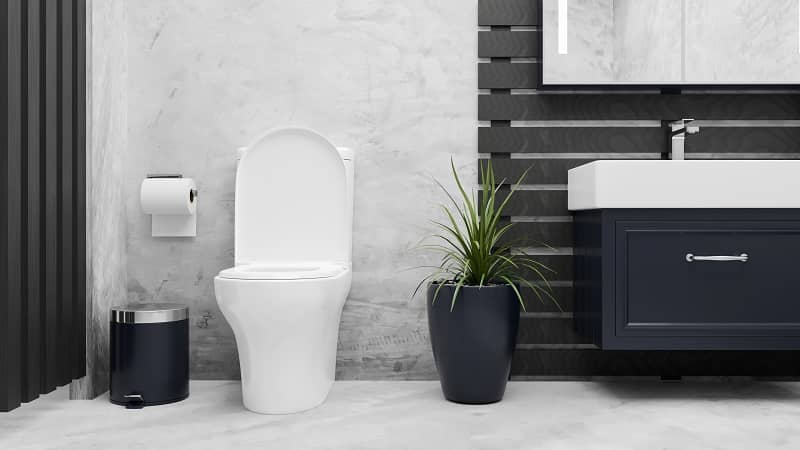
If you’ve ever used a public restroom (which we’re safely assuming you have), you’ve noticed that things don’t look too familiar when compared to your personal abode. Namely, public toilets are almost always oval-shaped as opposed to the round shape that dominates the residential bathroom space. So, what’s the deal? Why are public toilets elongated and normal toilets round? Here, we’re going to shed some light on this can conundrum.
Why public toilets are elongated.
It’s the commode code.
The most prominent reason you see public toilets sporting the same U-shape is that it’s required by code. Not quite the revelatory answer you were hoping for, huh? The International Association of Plumbing and Mechanical Officials (yes, that’s a real thing), set forth a code in 1955 that public toilets need to be elongated with an open front on the seat. Don’t worry, we’ll get into some of the motivations behind that requirement.
The space is accommodating.
Another reason for the U-form of public toilets is to give users more room for *ahem* going. No matter what kind of goods you’re bringing to the toilet, having additional space is a welcomed feature. Making contact with the inside of a public toilet is a universal fear, and elongated toilets help limit that potential. More circular designs wouldn’t offer nearly as much space. It’s tough to argue with that reasoning!
Front-wiping is much easier.
A primary motivation for the U-shape code requirement is to accommodate female users. The elongated bowl design along with the open-front seat makes it possible to access the more private areas without having to come in contact with the toilet. Of course, male users can benefit from this diligent design too.
Why private toilets are round.
It’s more comfortable.
Have you ever diligently sat down on a public toilet in what seems like the ideal spot only to continue readjusting over and over again? That perfect position to “go” seems as elusive as public toilets. As it turns out, circular toilet seats are much more accommodating to the human buttocks, which is why residential toilets are most commonly rounder in shape than their public counterparts.
Space is a priority.
Unless you’re heavily prioritizing bathroom real estate, your home commode is probably smaller than the average public facility. To optimize the teeny amount of space in which most residential toilets have to fit, the space-saving round design is preferred. You achieve the exact same result while saving about half a foot of highly coveted space. It might not sound like a lot, but it’s a big win if you’re trying to optimize space.
They’re relatively cheaper.
The most practical reason residential toilets are round as opposed to elongated boils down to economics. Circular toilets are generally more affordable than oval designs due to the fewer amount of materials used in the manufacturing process. Of course, there are many exceptions to this generalized rule, but it’s prominent enough to have an influence.
It’s the norm.
The status quo carries momentum in the bathroom as it does in all areas of society. For decades upon decades, round toilets have been the standard option for homebuilders and the decision has stuck. Sure, there are some people who opt for elongated toilets in their homes, but they’re the exception. Most people simply choose circular commodes because that’s what they’re most familiar with.
The Loo is Transforming Public Restrooms
The norms affecting oval vs round toilets make sense, but that doesn’t mean all bathroom standards are acceptable. Many cities are tired of being failed by the lack of viable, safe, and durable public restroom facilities. The Portland Loo is on a mission to solve this problem by offering all people a dignified place to “go” in public while still making sense for city managers. Contact us today to learn more about how the Loo can help your city.